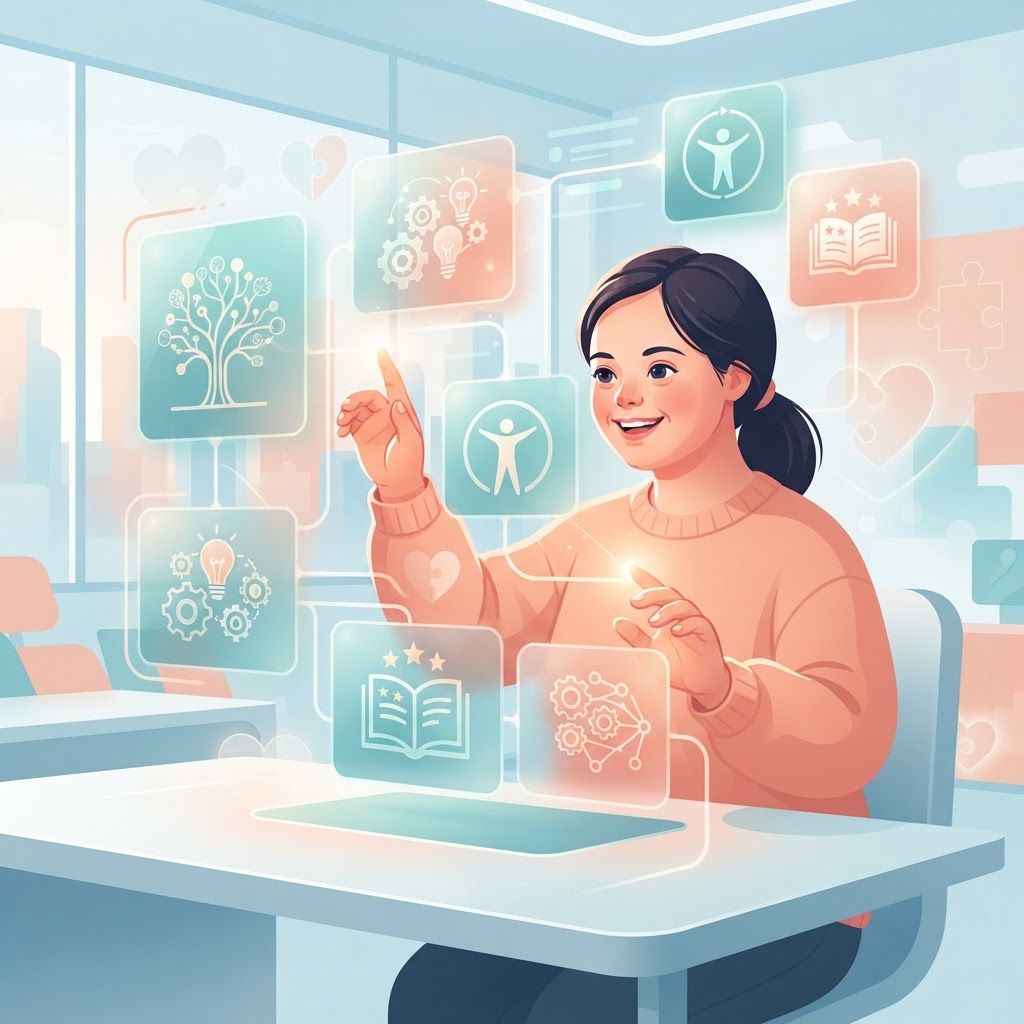
Down syndrome: information, autonomy and real life
An educational area of the Acolher TEA Project dedicated to Down Syndrome, organized without mixing diagnoses and focusing on development, health, inclusion, adult life, rights and protagonism of the person with a disability.
Each person is unique. The diagnosis does not define personality, interests, choices nor does it alone establish what someone will be able to learn, build or decide throughout their life.
Down Syndrome is a genetic condition related to the presence of extra material from chromosome 21. The most common form is trisomy 21. There are also forms due to translocation and mosaicism. The diagnosis does not alone determine personality, interests, autonomy or future possibilities.
Each person has their own profile of development, health, communication, learning and participation.
Avoid turning frequent characteristics into rules: two people with Down Syndrome can have very different needs and abilities.
Diagnostic information should be presented in respectful language, without reducing the person to the genetic condition.
Development, stimulation and participation
Development may occur at different paces, but continues throughout life. The focus of support should be to expand participation, communication, autonomy, learning and quality of life, and not pursue a single performance model.
In childhood, development monitoring may involve physiotherapy, occupational therapy, speech therapy and other areas depending on individual needs.
Playing, participating in family routines, exploring the environment and carrying out real everyday tasks are also learning opportunities.
Goals must make sense for the person and their routine, with periodic review and family participation when relevant.
Lifelong health
Some health conditions are more common in people with Down Syndrome, so clinical monitoring must consider the life cycle. This does not mean that everyone will have the same conditions.
Assessments of hearing, vision, sleep, heart health, thyroid and other aspects may be part of the follow-up depending on age, history and professional guidance.
Changes in behavior, sleeping, eating, mobility or participation can also be signs of health issues and deserve investigation before being interpreted solely as behavior.
Care must be individualized and integrated with primary care and specialized services when necessary.
Communication and language
Communication goes beyond speech. Some people may benefit from gestures, visual aids, or augmentative and alternative communication, temporarily or permanently.
Giving someone time to respond is different from responding for them.
Simple questions, real choices, visual support, and meaningful context can facilitate understanding and expression.
Communication should serve to participate, choose, refuse, ask for help, talk and build relationships.
Inclusive education
School inclusion is not just enrollment. It involves access, permanence, participation, learning, coexistence and real opportunities for development.
Low expectations can become a barrier. Planning must come from the real student, not from stereotypes about the diagnosis.
Adaptations, accessibility resources, pedagogical support and AEE must respond to the barriers observed in the school context.
Family, school and professionals can share useful information without turning the student into a set of difficulties.
Adult life, autonomy and choices
Autonomy does not mean doing everything alone. It means participating in decisions about one's own life and receiving the necessary support to make choices with safety and dignity.
Money, commuting, organizing a routine, self-care, leisure and community participation can be taught and supported gradually.
Adults with disabilities should not be infantilized. Preferences, privacy, consent and choices need to be respected.
The family can be an essential network without automatically replacing the person's voice.
Work, career and opportunities
People with Down Syndrome can study, work and build professional trajectories. Barriers to access, communication and social attitudes can limit opportunities more than the diagnosis itself.
Accessible recruitment, well-explained tasks, adequate training and support in the workplace can promote retention and development.
Work must be treated as a professional activity, with rights, responsibilities, remuneration and the possibility of growth.
Career also involves personal interests: communication, arts, fashion, sport, customer service, technology, services and many other areas.
Relationships, affection and sexuality
People with intellectual disabilities have the right to accessible information about their bodies, privacy, relationships, consent, violence prevention, and sexual and reproductive health.
Avoiding the topic does not protect. Clear and understandable information can increase confidence and the ability to recognize inappropriate situations.
Dating, affection, friendship and desire do not disappear because of a diagnosis.
Protection and autonomy need to be built together, and not placed as opposites.
Rights and social participation
In Brazil, people with Down Syndrome are covered by legislation protecting the rights of people with disabilities. Concrete rights depend on the context and criteria of each public policy.
Education, health, work, accessibility, social participation and protection against discrimination are part of the set of rights of people with disabilities.
Benefits and services have their own criteria; they should not be presented as automatic just by diagnosis.
For legal or administrative decisions, consult up-to-date official sources and, when necessary, professional guidance.
Representativeness and protagonism
Talking about inclusion without listening to people with disabilities produces an incomplete vision. Representation means creating space for people with Down Syndrome to talk about work, study, relationships, culture, barriers, dreams and decisions that concern their own lives.
Content about people with disabilities should avoid infantilizing exposure, charity as the central narrative and praise based solely on the diagnosis.
Interviews and personal stories must respect the person's own consent, context and authorship.
Protagonism also means recognizing differences: people with the same diagnosis do not need to think the same way.
Voices that Welcome
Nothing about us without us
The Project makes room for content created with people with disabilities, valuing first-person experiences, choices, work, study, relationships, culture, barriers and social participation.
This page uses official health documents and legislation as a basis, as well as public reference sources. Individual clinical recommendations must be defined by the team that monitors each person.
Notice: educational and scientific dissemination content. It does not replace medical, therapeutic, pedagogical assessment or individualized legal guidance.
Watch without leaving the website
Inclusive education and school participation
Complementary material on inclusion, accessibility and organization of support at school.
External content selected as an educational complement. The information and opinions presented in the video are the responsibility of the channel that published it.
We use essential cookies to operate the platform and record usage metrics through Base44 Analytics. We do not use behavioral advertising. Learn more in our Privacy Policy.